

ONLINE Glaucoma Surgery Eligibility Test
Are you wondering if you’re a good candidate for glaucoma surgery? Take our online aptitude test now and find out your results in just a few clicks.

The symptoms depend heavily on the shape of the glaucoma. Open-angle glaucoma, in particular, is often asymptomatic in the early stages – without pain and without noticeable visual impairments. This can cause irreparable damage to the optic nerve before those affected notice anything.
One reason for this is the compensation: slight visual field losses are initially compensated by the other eye and often begin peripherally, i.e. in areas that are less noticeable in everyday life. As an eye disease, the glaucoma therefore remains undetected for a long time until targeted early detection by the ophthalmologist brings clarity – ideally as part of regular preventive examinations.
Other forms are more obvious: acute narrow-angle glaucoma (glaucoma emergency) suddenly starts with severe symptoms (e.g. pain, visual disturbances, nausea) and is an emergency; congenital glaucoma can cause specific signs as early as childhood. Understanding these differences helps to correctly classify the presentation of the disease and to prompt clarification and glaucoma surgery.
Why glaucoma diagnosis is important: If several clues come together or there are risk factors, we secure the diagnosis with the measurement of intraocular pressure (tonometry, mmHg), OCT of the nerve cell/nerve fiber layer (RNFL) and a visual field test (perimetry). This allows us to detect changes early – before vision loss becomes noticeable.

Early detection of symptoms in cataracts is crucial because glaucoma usually begins without pain and early signs are often subtle. Typical are an increasing sensitivity to light, halos (colored rings around light sources) and uncertain vision at dusk. Early on, small visual field gaps arise at the edge, while the central visual acuity is often still good.
Frequently Cited Notices (without warranty):
Important: A single symptom does not automatically mean glaucoma. If several indications come together or there are risk factors, we recommend glaucoma diagnostics for clarification – with measurement of intraocular pressure (tonometry, mmHg), OCT (RNFL/nerve cells) and visual field test (perimetry).
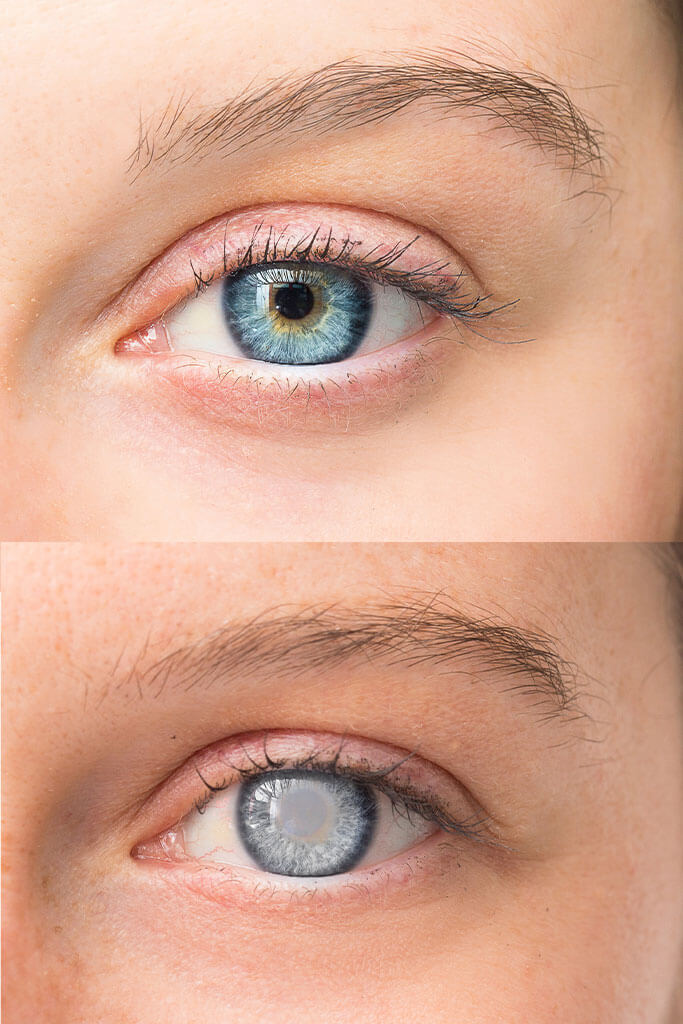

Glaucoma symptoms differ depending on the form of it. Open-angle glaucoma is usually gradual and painless with early visual field losses, while acute narrow-angle glaucoma suddenly causes severe discomfort.
Normal pressure glaucoma and congenital forms also show their own patterns. The following sections classify typical signs – so that optic nerve damage can be detected early.
Primary open-angle glaucoma is the most common form of glaucoma. The course is slow and often asymptomatic at first. Typical is a peripheral visual field loss, which is compensated by the brain for a long time; reading and central vision are initially preserved.
Later, light changes become more difficult, contrast sensitivity decreases and vision at dusk becomes uncertain – without pain and usually without redness; the most common cause is a disturbed drainage of the aqueous humor in the trabecular structure of the chamber angle.
In acute narrow-angle glaucoma, the intraocular pressure suddenly rises sharply. Key symptoms: severe headache/eye pain, red eye, vision loss, halos and nausea/vomiting; the eyeball works very hard. This is a medical emergency – please seek medical attention in the eye clinic/emergency room immediately.
In secondary glaucoma, other eye diseases (e.g. uveitis, diabetes mellitus), trauma or medication (especially cortisone) lead to an increase in pressure and damage to the optic nerve. The symptoms vary: redness, pain, pressure fluctuations or loss of visual field. The decisive factor is the therapy of the underlying disease plus consistent pressure reduction (drops, SLT, possibly surgical intervention).
In normal pressure glaucoma, optic nerve damage occurs despite intraocular pressure in the “normal range”. Notes are similar to open-angle glaucoma (peripheral visual field defects, decreasing contrast sensitivity). Frequently, circulatory disorders and nightly drops in blood pressure play a role – so regular checks are important.
Rare but typical indications: pronounced photophobia, lacrimation (epiphora), apparently enlarged cornea/eyes (buphthalmos) and redness. In case of suspicion: prompt examination – early treatment protects the nerve cells and the visual field.
Symptoms are clues, not evidence. Assurances provide accurate diagnostics for cataracts: tonometry (mmHg), OCT and perimetry.
ONLINE Glaucoma Surgery Eligibility Test
Are you wondering if you’re a good candidate for glaucoma surgery? Take our online aptitude test now and find out your results in just a few clicks.
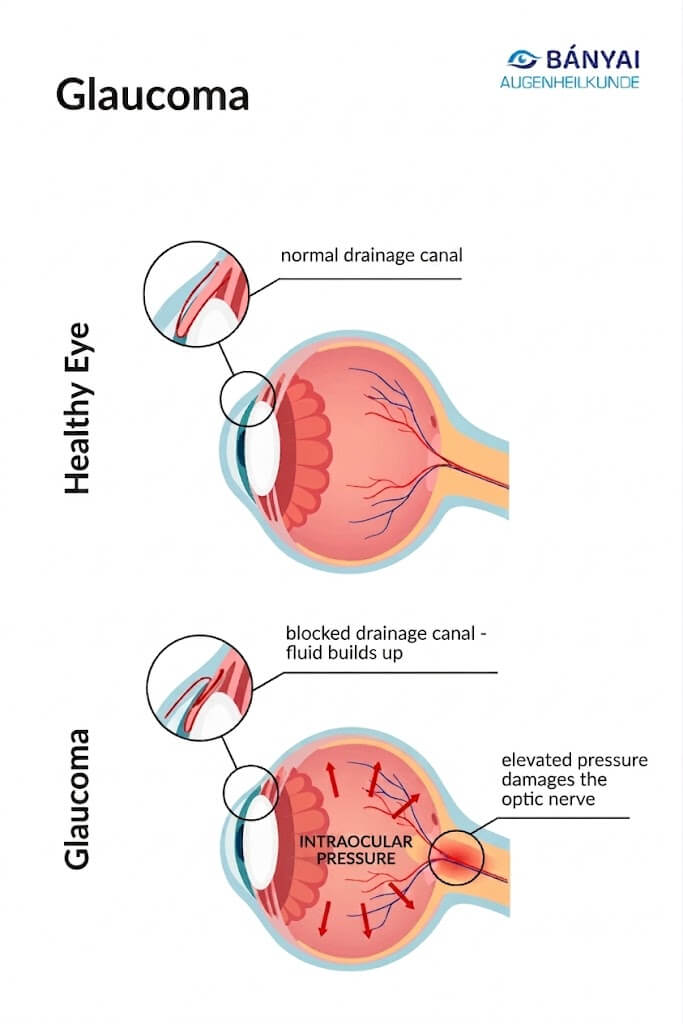
Glaucoma creepingly damages the optic nerve. Initially, nerve cells of the retina are lost; imaging (/OCT, RNFL) shows a thinning of the nerve fiber layer and an increasing excavation on the optic nerve head.
Functionally, there is a loss of visual field – first peripheral, later denser and more central. These damages are irreversible; the aim of the therapy is to stop or significantly slow further progression by reducing pressure (target mmHg).
In short: Discovered early, better protected: With tonometry (mmHg), OCT and visual field, we intervene early, set target mmHg and preserve your vision in the best possible way.
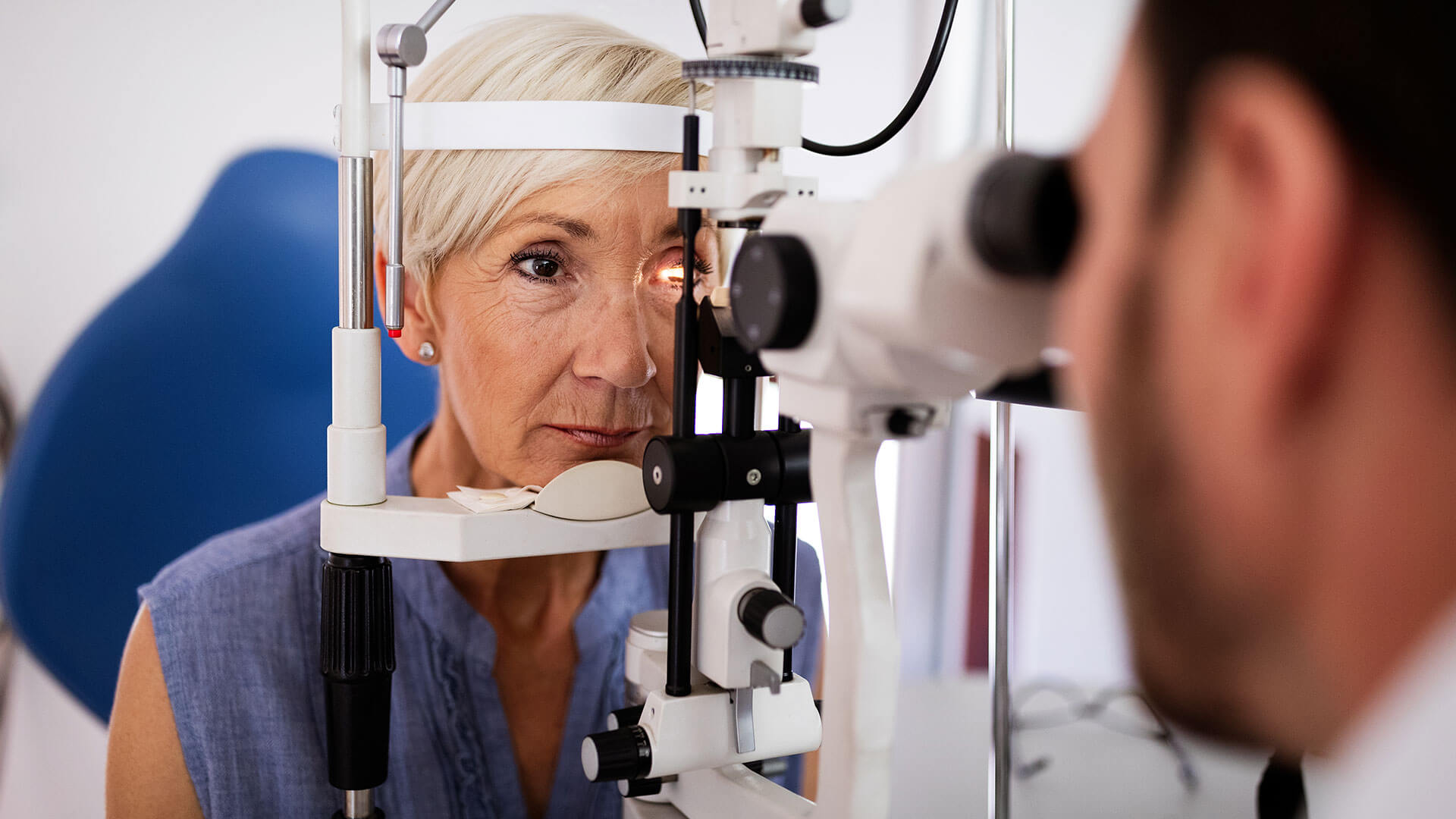
Glaucomaprevention means targeted early detection by the ophthalmologist and consistent controls. We regularly check the measurement of the intraocular pressure (tonometry, mmHg), the OCT (RNFL/nerve cells) and the visual field test (perimetry). In case of suspicion, we set an individual target value and determine the control intervals – depending on the glaucoma form, eye pressure, corneal thickness and personal risk factors.
What you can do yourself:
Book your personal consultation online now—with no obligation!
Laser Eye Surgery, Diagnostics & Consultations on Ophthalmology at the Bányai Laser Eye Center – Dr. Liliana Bányai
Glaucoma (cataracts) often does not cause pain at first. Typical are subtle visual field failures at the edge, more sensitivity to light and uncertain vision at dusk. Safety precautionary examinations at the ophthalmologist: measurement of the intraocular pressure (tonometry in millimetres of mercury column, mmHg), OCT of the nerve fibres/nerve cells and perimetry.
Glaucoma = eye disease of the optic nerve; often due to increased intraocular pressure due to impaired drainage of aqueous humor in the trabecular system/ventricular angle. Symptoms: creeping visual field losses. Therapy: pressure-lowering eye drops, laser treatments (e.g. SLT) or surgical intervention (e.g. trabeculectomy).
Cataracts = opacity of the lens of the eye; symptoms: blurred, glare-sensitive vision. Treatment: cataract surgery (lens replacement). Both diseases can occur side by side – the clarification is done by ophthalmology.
Sudden severe eye/headache, red eye, vision loss, halos, nausea/vomiting, very hard eyeball. The cause is a blocked chamber angle in the anterior chamber of the eye with very high intraocular pressure. Emergency – go to eye clinic/emergency room immediately.
Similar to open-angle glaucoma: insidious visual field failures despite apparently normal intraocular pressure. Commonly involved: blood flow to the optic nerve (nocturnal drops in blood pressure). Regular checks and an individually defined target mmHg are important.
Usually a high/increased intraocular pressure due to disturbed drainage of the aqueous humor in the trabecular system (chamber angle). The thickness of the cornea influences the measurement; the pressure is evaluated in mmHg and in the context of the target value.
Often 10–21 mmHg; the target value for your eye is decisive. The tonometry (e.g. Goldmann applanation) measures the pressure; if necessary, day curve. Supplementary: OCT and perimetry assess structure and function.
Pressure-lowering eye drops (e.g. prostaglandins) are often the first step. If this is not enough, SLT laser treatments or – at an advanced stage – a trabeculectomy are considered as surgical procedures. The choice is based on glaucoma form, eye pressure and findings.
Untreated yes – in the advanced stage, there is a risk of blindness. With early detection, appropriate therapies and controls, vision can be preserved in many cases in the long term.
Short-sightedness, diabetes mellitus, age (60+), family history, long-term cortisone therapy, sleep apnea and blood pressure fluctuations. In the case of risk factors, regular preventive examinations are useful.