Cataract, also known as cataract, is an eye disease that affects millions of people worldwide. This is a clouding of the lens of the eye that leads to blurred vision and other visual impairments.
The good news is that cataracts can be treated well these days, which significantly improves the quality of life of those affected. Cataract surgery is one of the most effective and safe methods used in the field of eye surgery.
First of all, the question of whether you can cure cataracts without surgery can quickly be answered with no. A cataract will worsen steadily and gradually without surgery. Even visual aids cannot bring about a cure, but only alleviate the symptoms for a certain period of time.
In this article, we will take a detailed look at treating cataracts. We will look at the different options, ranging from conservative methods to alleviate visual impairment to surgical procedures to cure cataracts.
A cure for cataracts can only be achieved by surgical intervention. However, there are also conservative methods to minimize the symptoms of cataracts, which can still be sufficient in the early stages to achieve the necessary vision. However, the further cataracts progress, the operation will become inevitable at some point.
In some early stages of cataracts, conservative methods can be used to relieve symptoms and slow the progression of the disease. These treatment options are particularly relevant if cataracts are not yet too advanced and vision is not severely impaired.
A common conservative method of improving vision is to use glasses, reading glasses, or contact lenses. These vision aids can compensate for the opacity of the lens and make vision sharper and clearer. The ophthalmologist or optician can prescribe the appropriate corrective lenses, which are specially tailored to the individual needs and the degree of opacity.
In addition, magnifying vision aids such as magnifying glasses or special readers can be of great use. These tools enlarge the text or image, making it easier to read and see objects. These aids can offer considerable relief, especially for finer work such as sewing or manual work.
However, it is important to note that conservative methods cannot cure cataracts. They are primarily used to alleviate symptoms and temporarily improve vision. If lens opacity progresses and vision is severely impaired, surgery will be required to effectively treat cataracts. Therefore, it is advisable to carry out regular check-ups with the ophthalmologist in order to monitor the progress of the disease and to initiate the appropriate treatment in good time.
Basically no. The treatment options here are very limited. Cataracts cannot be treated medically or otherwise. An operation is therefore inevitable. Only the glaucoma can be treated with certain medications.
The reason for this is the nature of the eye disease. The cataract is a progressive clouding of the lens. The only effective thing is the removal of the cloudy lens. This is replaced in the course of the operation (only a small incision at the edge of the cornea is necessary to open the lens capsule) by a new artificial lens (so-called intraocular lens – IOL for short). Two different types of lenses are used: monofocal lenses or multifocal lenses. Even more important than the lens type is that the lens is well adapted to the eye and has the right refractive power.
Green cataract (glaucoma) is a complex disease that causes damage to the optic nerve. One of the most important influencing factors is, for example, the increased intraocular pressure. This can be counteracted with certain medications. However, surgery is also unavoidable in some cases.
Grey cataracts can only be cured by surgery or by laser surgery. The safest and most gentle method is surgery with a femtosecond laser instead of scalpel surgery. At the Bànyai laser eye surgery center, the LENSAR laser is used for cataract operations.
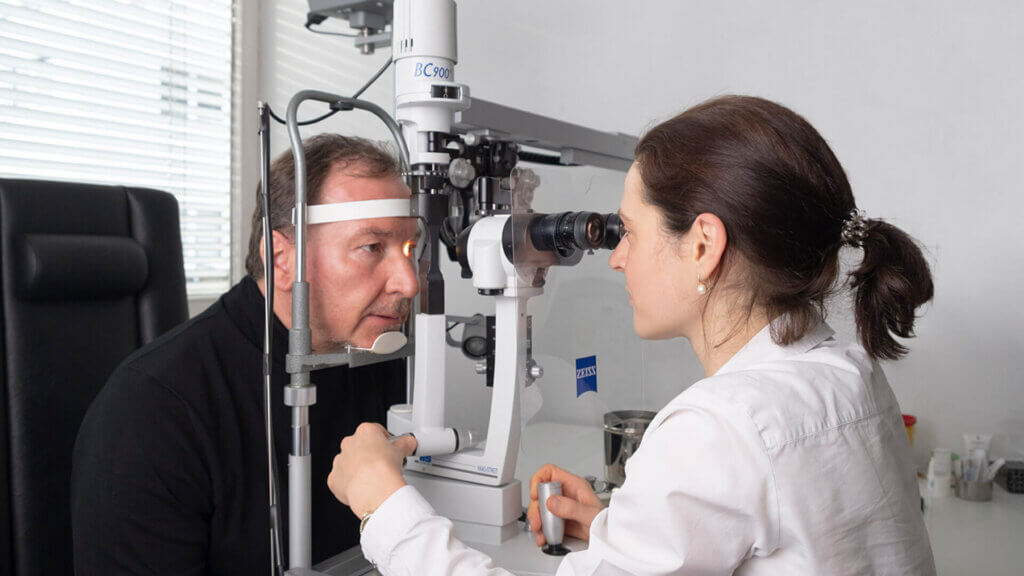
Before a cataract operation, the degree of cataract – i.e. lens opacity – must first be determined. During a preliminary examination, the degree of opacity of the lens of the eye is determined by means of a slit lamp. If this is strong enough, surgery can be performed.
With the support of special laser technology, the body’s own lens is removed and replaced by a new artificial lens. This is done using eye drops for local anaesthesia. The formerly clouded vision improves and a clear and brilliant image is created on the retina again. You will regain new vision!
This eye surgery is one of the most frequently performed procedures in Germany and thus an absolute routine procedure to be able to see better. The healing process after cataract surgery takes about 2 weeks.
Cataract is an eye disease that progresses further and further. The view is thus becoming increasingly cloudy and unclear. This leads to complete blindness. When cataracts should be operated on can be decided individually. If the symptoms of cataracts are making your everyday life more and more difficult, it is advisable to talk to your ophthalmologist and think about an early cataract surgery.
You should be aware of the following cataract symptoms:
If you do not want to have surgery, you will sooner or later go blind. Therefore, the only way is surgery. Laser treatment has many advantages: it is fast, safe and involves few risks. In addition, the laser treatment is painless and only takes a few minutes.
If the cataract is not operated on, the vision of the clouded eyes will initially deteriorate further. Glare sensitivity and blurred vision can lead to many dangerous situations in everyday life.
Sharp vision will no longer be possible at some point. The visual deterioration is becoming increasingly distressing. Shortly after diagnosis, blindness of the eyes is not to be expected. However, if the cataract remains untreated and progresses massively, it can lead to complete blindness. Therefore, do not be afraid of cataract treatment!
Probably the best way to deal with cataracts is laser treatment in an eye clinic. This form of treatment only takes a few minutes and is extremely gentle on the eye. The operation takes place under a local anaesthetic. Laser eye surgery for cataracts is painless.
The Lensar laser used is gentle on the eyes during the procedure. If your eyes become irritated or dry after the operation, E-EYE treatment can be used.
If you want to find out more and in more detail about the cataract, it is best to visit one of our info evenings. Here you will be informed in detail by the ophthalmologist about the cataract, its development as well as the treatment and the possibility of a possible freedom from glasses for a lifetime.

If you would prefer a private consultation, we recommend a personal consultation in our ophthalmologist’s office. As part of the consultation, we will also examine your eyes. This allows us to determine the present eye disease or refractive error and its degree. We will inform you about all forms of treatment and can also advise you on the best form of treatment for you.
Possibilities for obtaining information:
Some people have a corneal curvature in addition to cataracts. Special lenses are then used by the surgeon for the new lens to additionally compensate for this curvature.
In most cases, the statutory health insurance companies only cover the costs for standard lenses – but not for premium lenses. You should always inform yourself in advance with your responsible health insurance company. Learn more about cataract surgery costs.
An occasional side effect when using an artificial lens is the so-called “aftercataract” – a slight clouding of the capsular sac in the operated eye can occur – but this is easy and quick to medicate.
The eye disease cataract has long been known as such. The surgeon Antyllos is said to have treated people whose eyesight was impaired due to cataracts as early as 140 AD. How exactly is not known. What is certain, however, is that this procedure is not remotely comparable to today’s.
In the Middle Ages, there were stargazers or oculists. As the name suggests, the cataract, or clouded lens, was simply pressed into the inside of the eye. One of the most famous was Doctor Eisenbart. Due to enormous advances in technology, it is now possible for the cataract to be treated gently and gently with a laser and for you to regain your visual acuity. An aging process that can be corrected today. This makes the annual cataract screening at the ophthalmologist all the more important in order to treat it quickly and effectively.
No, the cataract cannot be cured without surgery. Conservative methods can relieve symptoms, but only surgery can effectively remove the cloudy lens and replace it with a clear artificial lens to restore vision.
The cataract should be operated on if the opacity of the lens severely impairs vision and affects everyday life. The exact time depends on the individual situation and should be determined in consultation with an ophthalmologist.
Cataracts are usually treated by surgery, in which the cloudy lens is removed and replaced with a clear artificial lens. Conservative methods can temporarily relieve symptoms, but only surgery permanently restores vision.
Hat Ihnen dieser Beitrag gefallen? Teilen Sie ihn mit anderen!