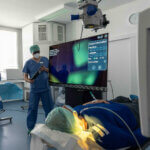

Cataracts are one of the most common eye diseases. But this disease can be treated well by a routine procedure. During eye surgery, the cloudy lens is removed and replaced with an artificial intraocular lens. The eye is locally numbed. Cataract surgery is minimally invasive. A fine scalpel is used to make a two to three millimetre long corneal incision. The procedure can also be performed using a laser. The LENSAR laser in the Bányai ophthalmologist in Stuttgart-Mitte, Böblingen and Leonberg is extremely precise and extremely safe.
Read the detailed procedure for cataract surgery below. Our cataract surgery aptitude test can inform you in advance whether you are suitable for cataract surgery or not.
During the preliminary examination of cataract surgery, the relevant eye parameters are measured and checked on the patient. In this way, it is determined whether an operation is the right solution at all.
It is also determined which artificial lenses, whether multifocal or monofocal, are suitable for the eye. In a detailed consultation, the doctor will inform you about the options, the surgery, the cataract surgery costs, the risks and the subsequent recovery time.
A thorough pre-treatment is important for the success of the actual operation. Modern technology makes the examination as pleasant as possible.
Most cataract operations are performed on an outpatient basis. Upon arrival at the operating room in Böblingen, Leonberg or Stuttgart-Mitte, log in at the counter at the scheduled time. You should come to the practice with an accompanying person. The stay will last approximately three hours, including preparation and follow-up as well as surgery. The cataract surgery itself usually takes only 20 minutes. Wear comfortable clothing and do without make-up and jewellery.
The Bányai Augenheilkunde team is at your side with a lot of expertise. Ms. Doctor-medic Bányai has a lot of experience in the surgical treatment of cataracts.
The cataract surgery duration is short and painless. The lens opacity is eliminated. The eye is pacified with state-of-the-art drop anaesthesia. The ophthalmologist performs the surgery using a high-resolution microscope. A bandage protects the operated eye after the operation. Full vision is restored after a few days. The cataract surgical procedure looks as follows:
In a first step, the affected eye is placed wide open with eye drops and numbed. This way, you won’t feel anything during the operation — cataract surgery pain is effectively avoided. This local anaesthetic is a gentle method for the rest of your body. In order to give you more peace of mind, additional sedatives can be administered.
Mild twilight anaesthesia would be another option, but in most cases it is not necessary, just like general anaesthesia.
Your face is covered with a thin sterile cloth, only the eye to be operated on remains free. Breathing and speaking is possible. The eye is kept open with an eyelid opener. Drops containing iodine sterilize the eye.
During the operation, the opaque lens is shredded with high-frequency ultrasonic waves using phacoemulsification. First, the surgeon makes a two to three millimetre incision in the lateral cornea of the eye. Viscous fluid is injected into the eye to maintain eye pressure and protect the structures of the eye.
The doctor removes the thin anterior skin of the lens capsule. An ultrasound probe is brought to the lens through the opening in the cornea. The vibrations of the fine titanium needle crush the hardened and clouded lens core into tiny particles that are removed with a suction tip. The posterior parts of the lens capsule are preserved, they support the implanted artificial lens.
Another option is a femtosecond laser LENSAR. With high precision and safety, it takes care of all the necessary cuts. He crushes the clouded lens and removes it. The high-precision LENSAR laser is used in Bányai Augenheilkunde.
The folded artificial lens is inserted into the eye through the small corneal opening. The lens then unfolds spontaneously. It is brought into the correct position and fixed in the capsule bag with tiny integrated holding brackets on the capsule walls.
The following lens types are used for this purpose. A monofocal lens has only one focal point, a multifocal lens has several. With the former, you are dependent on reading glasses; with the latter, you no longer need glasses.
After cataract surgery, the operated eye is protected by an ointment dressing or a watch glass dressing. The patient is observed for about half an hour after surgery. Then he may leave the practice premises. Under no circumstances may he drive a car himself directly after the operation, but is dependent on the help of an accompanying person. On the day of the operation, you should protect your eyes and preferably keep them closed.
The dressing remains in place until the next follow-up examination the day after surgery. There, the correct fit of the artificial lens is checked and the healing process is monitored.
In the following days, turbidity, itching, tears and possibly a certain foreign body sensation in the eye are normal. To optimize healing and avoid complications, you need to use antiseptic and anti-inflammatory eye drops daily. You should not rub or squeeze the operated eye. No soap should get in the eye while showering. You should also refrain from swimming pool and sauna visits. Avoid heavy lifting and dusty locations.
In the first few days, you will still have blurred vision. The eyesight of the operated eye improves with each passing day. Recovery time after cataract surgery usually takes about two weeks. Final visual acuity should be achieved six to eight weeks after cataract surgery.
Cataracts can be operated with the phacoemulsification technique. The doctor uses a scalpel to make a two to three millimetre incision in the lateral cornea of the eye. But the scalpel can also be replaced by a laser beam from a modern femtosecond laser.
The advantages of cataract laser eye surgery are:
The LENSAR laser makes the procedure even easier and safer. The Bányai centers are equipped with this innovative device. Each step of the operation is planned and monitored by the doctor. Only partial steps approved by the surgeon are carried out by the laser. Don’t be afraid to contact your ophthalmologist if you have cataract symptoms.
In cataract surgery, the clouded lens is replaced by an artificial one. The procedure is performed under local anesthesia. The surgeon makes a small incision in the eye, removes the clouded lens and inserts the artificial lens. After a short observation, the patient can leave the surgical center again.
The cataract surgery usually takes less than 20 minutes. After an observation time of about 30 minutes, the patient can go home again.
During cataract surgery, the eye is locally numbed with drops. After cataract surgery, there may be slight pain, a feeling of pressure or itching in the eye. These symptoms can be relieved by painkillers and usually subside after a few days.
The eye is stilled by local anaesthesia using drops. Another option is mild twilight sleep anaesthesia.
The procedure can be performed using ultrasound technology or laser technology.
Multifocal lenses for an optimal result without restrictions. Monofocal lenses that correct either distance or proximity.
No. Only one eye is operated on. The second eye should be treated promptly.
Hat Ihnen dieser Beitrag gefallen? Teilen Sie ihn mit anderen!