
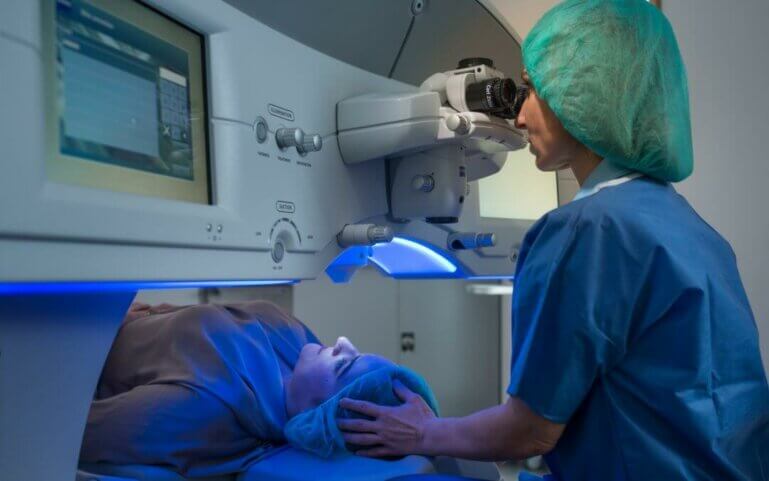
When talking about laser eye treatments, many people think of a life without glasses. However, eye lasers are not only used for cosmetic reasons.
Defective vision and eye diseases that we can treat are, for example: nearsightedness, farsightedness, corneal irregulatory, retinal detachment, presbyopia, macular degeneration, keratoconus, aftercataract, cataract surgery and glaucoma.
Rather, laser interventions most often treat an eye disease, such as retinal holes or diabetic rhetinaphobia. Health insurance companies pay for these treatments, which are not to be confused with vision correction.
Cataract is usually the cause when an originally healthy eye lens becomes cloudy. This clouding increasingly impedes vision. In most cases, people over the age of 60 are affected. Only surgery helps, in which the clouded lens is replaced by an artificial lens. The femtosecond laser has now established itself as a gentle surgical method for cataracts. The laser gently prepares the lens for uncomplicated cataract surgery.
ReLEx smile is considered the most innovative method for correcting vision defects, so it helps those people who want a life without glasses. It puts minimal strain on the cornea and is virtually painless. ReLEx smile corrects nearsightedness exactly, even severe visual defects and corneal curvatures (astigmatism) are not an obstacle. To treat farsightedness, the proven Femto-LASIK method is considered the first choice.
Femto LASIK is a further development of classic LASIK (laser in situ keratomileusis). Precisely and safely, it corrects farsightedness, nearsightedness and corneal curvatures.
In Femto-LASIK, a very fine laser produces the so-called flap, whereby the upper corneal layers are not touched at all. This way, patients can already see that their vision has improved the day after the procedure. Femto LASIK is almost painless. Have your long-sightedness lasered.
Which laser method is suitable for you? Take our online aptitude test!
Hat Ihnen dieser Beitrag gefallen? Teilen Sie ihn mit anderen!