
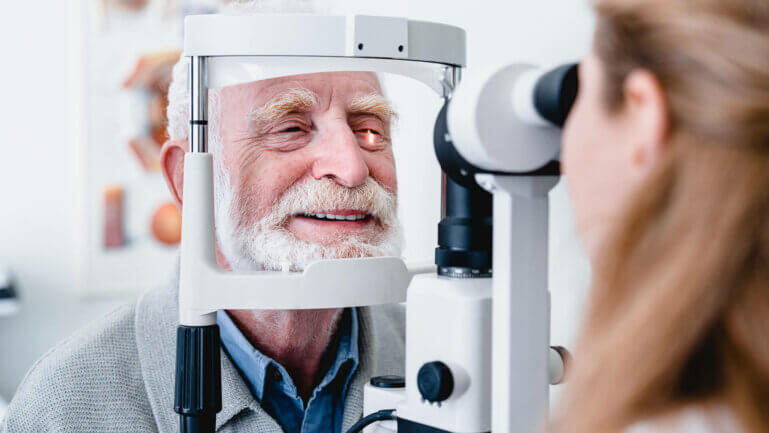
With increasing age, our vision deteriorates sharply and age-related eye diseases such as cataracts are also a reality for many people in Germany. Therefore, an annual check-up with the ophthalmologist is recommended from the age of 50. Why? You can find out in the following post.
Everyone knows how important our eyesight is in everyday life. Anyone who has ever tried to find their way around in complete darkness knows how difficult this is. Eyesight is important for our orientation and perception of optical stimuli. With good eyesight, we remain mobile in everyday life. That is why an annual ophthalmological check-up is very important.
Our eyes are the most important, but also the most sensitive sensory organ. It accompanies us uninterruptedly in everyday life. The eye is constantly under stress. With increasing age, the elasticity of the lens decreases and the performance of our eyes decreases. That is why it is important to prevent cataracts at an early stage and to go to cataract prevention every year.
During the ophthalmological inspection, the entire organ eye is checked. This includes the eyelids, tear organs, conjunctiva, cornea, lens and any changes in the eye structure are checked. That is why it is also important that you take older findings and documents from previous eye diseases or operations with you.
If available, it is important to take the following with you to check with the ophthalmologist:
The cataract is already detected by the ophthalmologist during the routine examination. He examines you with a slit lamp and also carries out a vision test. Further examinations are necessary if, for example, there are other diseases, such as diabetes mellitus.
As the opacity of the lens increases, the permeability of the lens to light rays is impaired. The course of cataract, as the cataract is called, is insidious.
Typical cataract symptoms are blurred vision and a grayish, milky vision or veil. Contours, colours and contrasts become paler. In addition, there is an increase in glare sensitivity. In addition, spatial perception deteriorates and thus also the ability to orient oneself. This is comparable to a dirty car window against which the sun shines.

After diagnosis, the attending ophthalmologist will register the patient for surgery. Unfortunately, the cataract does not regress on its own. For this reason, surgery is the only way to treat cataracts. The procedure is painless and routine for experienced surgeons.
The cataract preliminary examination consists of a complete ophthalmological examination. This is performed a few days to weeks before cataract surgery. Your eye will be thoroughly examined and measured again. This is important for calculating the refractive power of the artificial lens (monofocal lens or multifocal lens).
As a rule, you must drip the drops prescribed for you into the eye to be operated on three times a day 3 days before the operation. Before the operation, you will receive information sheets on the course of the operation.
On the day of cataract surgery, you should drink a lot and rest. On the following day, a follow-up examination is required with your attending ophthalmologist.
During the operation, the clouded lens is removed and replaced with an artificial lens using the LENSAR laser. This preserves the lateral and posterior eye capsule. Learn more about the exact procedure of cataract surgery.
Yes, cataracts can be cured very well nowadays if they are detected in time. Unfortunately, there is no alternative to cataract surgery. Normally, the lens does not need to be replaced again.
However, clouding of the capsule may occur over time. This is called a aftercataract. This can be eliminated with an eye laser treatment.
You can find out whether you are suitable for cataract surgery online via the free aptitude test.
In the case of aftercataracts, the capsule behind the lens becomes cloudy over time, which increasingly worsens vision. The therapy is completely uncomplicated with a simple laser treatment.
The cataract is usually operated on if there are problems in everyday life. However, you should not wait too long, as the procedure is easier and less risky at the initial stage. In addition, you must bear in mind that as a motorist you endanger yourself and other road users. In the elderly, the risk of falling increases due to poor vision. In patients with less than 70% vision, the procedure should be performed relatively quickly.
Usually 1-2 weeks. Depending on the professional situation, also longer. After the operation, everything is allowed again, including bending down. The healing process will be complete in 6-8 weeks.
Yes, that is generally possible without any problems.
Hat Ihnen dieser Beitrag gefallen? Teilen Sie ihn mit anderen!