
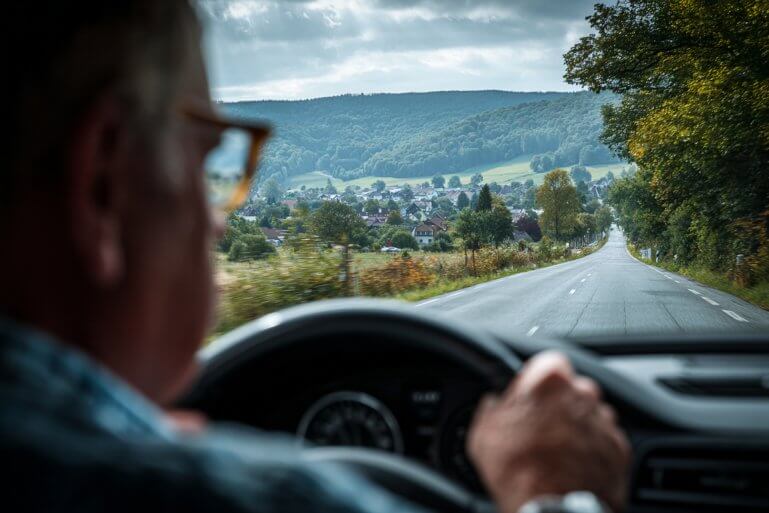
If you’ve been diagnosed with glaucoma, it often raises many questions—not least about your mobility in everyday life: Can I still drive? Does this affect my job? What factors should I be aware of?
In this article, we’ll explore how you can remain flexible and safe in your daily life despite having glaucoma, covering driver’s license regulations, eye function, roadworthiness checks, and everyday tips for greater safety.
In glaucoma, damage to the optic nerve often goes unnoticed at first. Although central vision is often preserved for a long time, peripheral vision may be impaired.
Studies in ophthalmology show that a restricted field of vision can have a negative impact on driving safety.
In everyday life, this means that you may notice obstacles or other road users later than usual, and it may become more difficult to judge speeds, distances, or changing lighting conditions—especially when driving at dusk or dawn and if you are sensitive to glare.
In Germany, certain minimum vision requirements are mandated for driving. Among other things, visual acuity, visual function, and visual field must meet the specified standards.
For people with glaucoma, this means that in addition to a vision test and the standard visual acuity assessment, a visual field test and, if necessary, specialized examinations should be performed. As your ophthalmologist, I will guide you through your eye exams, and together we will discuss the extent to which your ability to drive remains unchanged or needs to be adjusted.
To remain mobile even with a diagnosis of glaucoma, certain requirements must be met. Your central visual acuity must be sufficient—usually even with correction from glasses or contact lenses. In addition, you must have an intact visual field that allows for quick reactions in traffic.
It is also crucial to consistently undergo regular checkups and monitor the course of treatment. People who are aware of their eye condition and take the necessary steps to stabilize it can generally continue to drive safely—provided that their healthy eye compensates for any potential limitations.

Not every diagnosis of glaucoma must automatically be reported. Reporting such a diagnosis becomes particularly important when visual acuity deteriorates significantly.
For example, due to new visual field defects, a worsening of the disease’s progression, or unstable intraocular pressure that could impair your vision while driving and thus increase the risk of an accident.
In these situations, the focus is not only on your own safety, but also on the safety of other road users.
Legal requirements vary from country to country: In the United Kingdom, for example, there is a clear reporting requirement for glaucoma in both eyes.
In Germany, however, there is no provision for automatic notification to the driver’s license authority.
The driver’s license authority decides on a case-by-case basis—often based on the Driver’s License Regulation (FeV)—whether restrictions or conditions are necessary, such as an ophthalmologist’s report or a requirement for regular checkups.
If there are doubts about a person’s fitness to drive, the authorities may take action on their own initiative and require the person to take a test.
Similarly, doctors may be required to notify the appropriate authority if they determine that a patient continues to drive actively despite serious limitations and thereby poses a danger.
However, this is always done after weighing medical assessments against professional regulations. The recommendations of the German Ophthalmological Society and the BVA (Professional Association of German Ophthalmologists) are also taken into account.
At Bányai Augenheilkunde, we help you assess the situation realistically. Together with you, we regularly check your relevant visual functions.
In particular, we will assess your visual acuity, contrast sensitivity, visual field, and the health of your optic nerve, and provide you with information about your individual fitness to drive.
To help you go about your daily life with as few restrictions as possible, here are a few recommendations:
Maintaining stable intraocular pressure is crucial to preventing glaucoma from progressing and preserving your vision.
To achieve this, consistent use of the prescribed eye drops is just as important as regular eye exams.
Patients who consistently adhere to their treatment are usually able to continue driving in the long term and lead a largely normal daily life.
Even in cases where visual field changes are already present, targeted adjustments can often ensure safe mobility.
Intraocular pressure is monitored at intervals tailored to your individual needs—depending on how stable your readings are and how far the disease has progressed.
At Bányai Augenheilkunde, we take the time to discuss with you how often you should have eye exams and which treatment options are most effective for your specific situation.
If eye drop therapy is no longer sufficient, modern, minimally invasive procedures are available. These include gentle laser treatments such as selective laser trabeculoplasty (SLT). In many cases, concurrent cataract surgery can also help lower intraocular pressure.
We tailor all of these options individually to your visual needs, your optic nerve, your retina, and the progression of your condition—with the goal of preserving your vision and quality of life.
Mobility means more than just driving. Other aspects of your daily life can also be affected by glaucoma.
When it comes to public transportation, it can be helpful to use buses, trains, or ride-sharing services as flexible alternatives—especially when driving your own car becomes increasingly risky.
Extra caution is required when driving at night or at dusk, as limited lighting conditions can further impair vision. In some cases, it is advisable to deliberately avoid driving in these situations.
You should also assess your work and personal activities for visual strain: working with computer screens, frequent changes in lighting while working in the field, or certain sports can also pose a challenge. We’ll work with you to determine whether and what adjustments make sense in your daily life.

A diagnosis of glaucoma does not automatically mean the end of your mobility—on the contrary: With early detection, well-supported treatment—such as glaucoma surgery—and a realistic assessment of your driving and vision, you can continue to maintain your independence and drive safely.
Key factors here include regular eye exams, consistent adherence to the recommended treatment, and an honest assessment of one’s own vision, especially with regard to driving.
Open communication with your eye doctor is just as important.
If you’re wondering how you can stay mobile in the future, we’re here to help. At Bányai Augenheilkunde, we’ll work with you to develop a personalized strategy that fits your needs and your daily life.
Even when taking into account comorbidities such as macular degeneration, nearsightedness, farsightedness, or visual impairment.
We would also be happy to consult with you in person about glaucoma surgery at our laser eye surgery center in Stuttgart or at our laser eye surgery center in Karlsruhe.
Yes—if your central visual acuity is sufficient and you do not have any significant visual field defects. Your ophthalmologist will review the requirements with you.
If your vision deteriorates significantly or a medical certificate is required. If you fail to disclose this information without being asked, your insurance coverage could even be at risk.
Yes—especially when driving at night or at dusk, in strong backlight, or when your field of vision is already limited.
That depends on the status of your glaucoma. Generally, eye exams are scheduled at least every six months or, if your condition is stable, once a year. We will develop a personalized plan for you at our practice.
As people age, they often experience a natural decline in vision, frequently as a result of cataracts. In such cases, driving is permitted as long as vision, with corrective lenses, is at least 50%.
Hat Ihnen dieser Beitrag gefallen? Teilen Sie ihn mit anderen!