About one in 2,000 people in Germany has keratoconus. This eye disease is characterized by a cone-shaped deformation and thinning of the cornea. It most often occurs in younger people between about 15 and 30 years of age and is incurable. However, modern treatment methods such as the “Corneal Crosslinking & LASEK” procedure, offered at the Bányai eye center, can prevent the disease from progressing.
A rapid deterioration in vision is an early symptom of keratoconus. Those affected therefore often need new glasses or special rigid (form-stable) contact lenses. The corneal deformation characteristic of the disease leads, among other things, to blurred vision, nearsightedness, and increased sensitivity to glare. In advanced stages the cornea becomes so thin that it is mechanically unstable. Glasses and contact lenses can then no longer provide the desired improvement. Until recently, only a corneal transplant could help.
Ophthalmic research has developed a procedure that can stabilize the cornea and halt the progression of the disease. Using a special photochemical process – cross-linking – the cornea is reinforced, preventing further deformation. The refractive error can then be corrected with LASEK. This modern therapy for keratoconus is carried out by ophthalmologist Doctor-medic Bányai at her eye surgery center in Leonberg near Stuttgart and at a total of five locations in southern Germany.
Corneal crosslinking works by combining ultraviolet (UV) irradiation with the application of riboflavin (vitamin B2) eye drops. First, the corneal surface (the epithelium) is abraded or removed. Riboflavin is then instilled onto the cornea, where it penetrates deeply into the tissue. The goal is to increase the number of cross-links between the parallel corneal fibers to enhance the cornea’s mechanical stability. To intensify this effect, the cornea is subsequently exposed to ultraviolet light, which causes it to stiffen further.
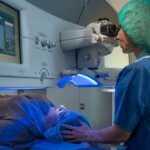
The procedure is performed on an outpatient basis under local anesthesia and lasts only a few minutes. To speed up the healing process, a bandage contact lens is inserted after the procedure and remains in the eye for a few days.
In most cases, cross-linking can prevent the progression of keratoconus. However, the patient’s significant visual impairment initially persists. To treat this, we perform a laser eye treatment (LASEK) as the next step. This achieves a marked improvement in visual acuity. Patients will still need to wear glasses, since complete correction is not possible, but progression of the keratoconus is not to be expected.
A number of scientific studies into the benefits of the cross-linking procedure have shown that it has a significantly positive effect on disease progression. If you are interested in cross-linking, we will be happy to advise you. Just get in touch us or come to one of our information evenings.
Hat Ihnen dieser Beitrag gefallen? Teilen Sie ihn mit anderen!