
Do you have the impression of perceiving colors gradually or suddenly less pronounced? Do you find it difficult to distinguish between individual colours or do you perceive colour contrasts worse than before? Are everyday things like reading or driving harder than usual?
Then you should clarify this with a specialist. In addition to harmless causes such as diminishing eyesight or poor colour vision, serious eye diseases such as cataracts can also be behind the loss of colour. If the cataract is the cause, it is worth considering cataract surgery. A simple procedure, which we will now explain to you here.
If color contrasts are no longer perceived correctly, this can have various causes. Contrasts of letters also become blurred and are an increasing problem when reading. The most common disorder of color vision is congenital color vision weakness or color blindness. One or more types of color receptors are not functional or are less sensitive.
However, these can also be serious diseases. In the case of a cataract, for example, the light is already refracted in the wrong way in the eye. As a result, colour perception increasingly deviates from the visual standard.
Colours are created in the human visual organ when light strikes our eyes. Our visual system processes the sensory stimuli triggered by electromagnetic radiation, the visible portion of which is referred to as light, creating the impression of colour on the retina of the eye.
There are cones and rods on the retina. The light hitting the retina excites the different types of pins, depending on the frequency. By combining the cones, which are stimulated, the processing in the nerve cells and in the brain leads to a specific color impression.
In addition to the approximately seven million cones, there are approximately 120 million rods on our retina. The task of the rods is to perceive light-dark contrasts. The sticks also allow you to see at night. For this reason, we can see light and dark patterns in the dark, but not perceive colors.
A color vision deficiency is a color sense disorder in which certain shades can be seen more poorly due to a malfunction of the cones. The most common form of color vision weakness is the red-green weakness, in which reds and greens can hardly be distinguished from each other.
Colour vision deficiencies are inherited recessively via the X chromosome and therefore occur more frequently in men, as they only have one X chromosome. Colour vision deficiencies can also be caused by a disease of the retina or the optic nerve. People with blue-yellow vision impairment may be particularly affected.
In the case of partial color blindness, a color cannot be perceived because the cones for this shade do not work or are completely missing. Complete color blindness is a rare disease in which sufferers can only perceive the world in shades of black, white, or gray. The technical term for complete color blindness is achromatopsia.
Those affected are often unaware of whether they suffer from colour vision impairment. Affected people who were born with color vision deficiency know no other way, while a slowly deteriorating color perception is often noticed very late by those affected.
For this reason, there are special tests that can be used to determine whether someone suffers from color vision impairment. In these, the colour perception is tested, for example, by colour charts. You can have these tests and other diagnoses carried out by Ms Doctor-medic Bányai in the ophthalmologist’s office. Accurate diagnosis is important to clarify next treatment steps.
“Cataract” can also impair contrast perception and colour vision. In this case, the color blue is particularly affected. Affected people only recognize this color when it is a clearly recognizable, stronger blue.
For this reason, changes in colour perception should always be discussed with a specialist. You are welcome to arrange an ophthalmology consultation at one of our locations. Wondering if you are eligible for laser treatment? Then use our online cataract aptitude test.
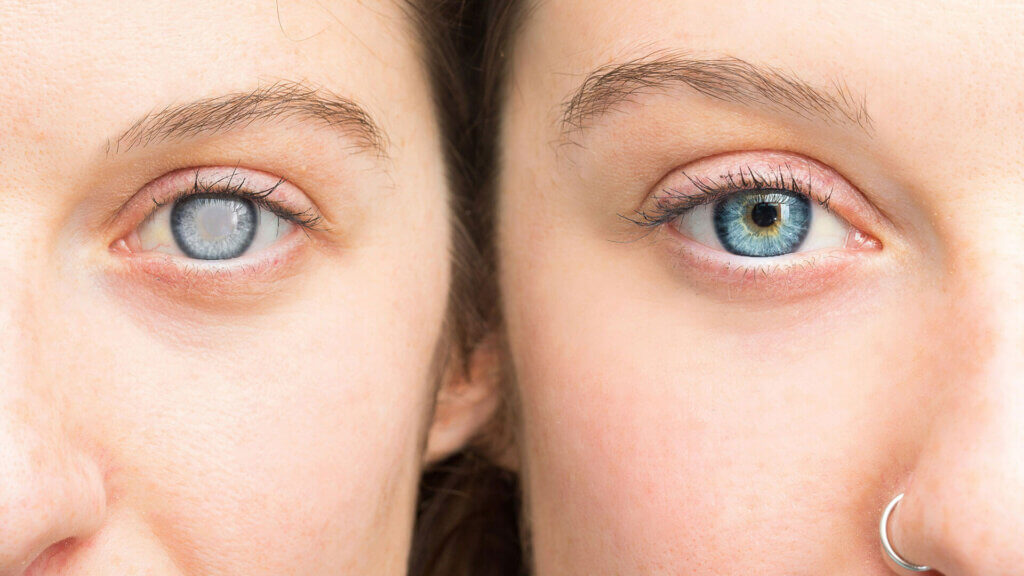
The “cataract”, also called cataract, is an eye disease in which the actually clear lens in the eye becomes increasingly cloudy. As a result, vision decreases steadily. The disease is treacherous because, untreated, it progresses slowly but steadily.
Triggers for the disease are an advanced age, metabolic diseases as well as malformations and injuries in the eye. Since the disease leads to blindness if left untreated, cataracts are usually treated surgically.
Typical symptoms of cataracts are an increased sensitivity to glare, the feeling of seeing the world in a blurred way or a worsened light-dark adjustment of the eye.
Colours often appear greyed out for patients suffering from cataracts. Even if everyday things such as driving, watching TV or reading are suddenly exhausting for the eye, this can indicate a cataract.
Cataract surgery using an eye laser is a sensible alternative to counteract the disease. With eye lasers, you can improve your vision again and take action against the age-related progression of cataracts. We will be happy to advise you personally in our laser eye centre in Karlsruhe or in the laser eye centre in Stuttgart.
Hat Ihnen dieser Beitrag gefallen? Teilen Sie ihn mit anderen!